


Introduction
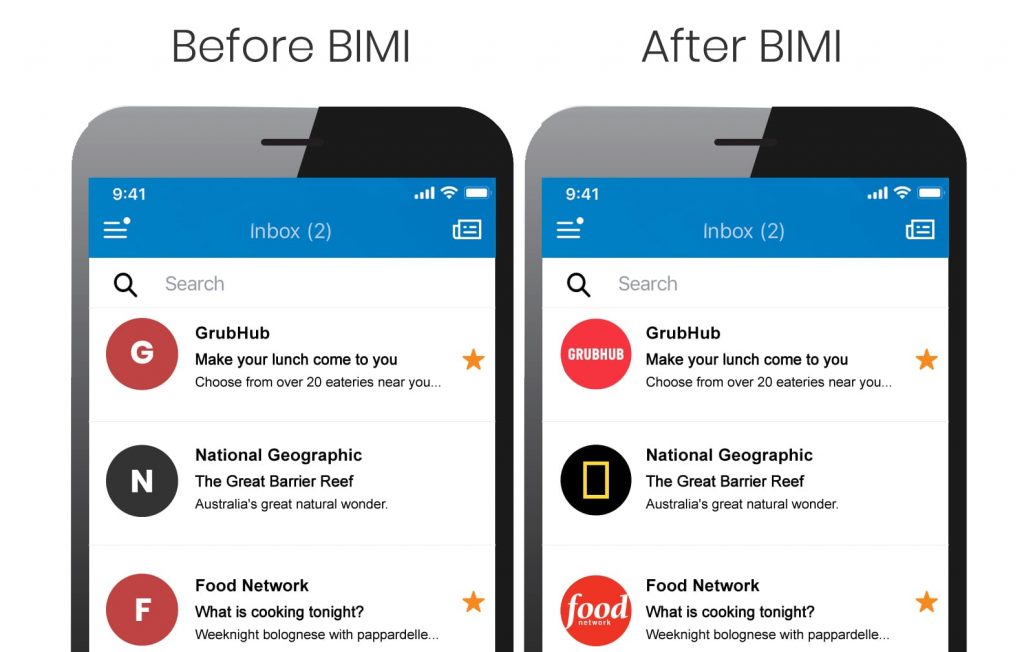
Brand Indicators for Message Identification (BIMI) is changing the way companies present themselves in email inboxes. It allows businesses to display their verified brand logo next to outgoing emails, helping subscribers instantly recognize legitimate messages. Backed by major industry players, BIMI builds upon existing email authentication protocols such as DMARC to enhance brand visibility, trust, and engagement. In short, it doesn’t just make your emails look better—it makes them safer, more credible, and more effective.
What is BIMI?
Brand Indicators for Message Identification (BIMI) is a standard that provides an easy and uniform method for companies to display their logos next to the email messages they send to their subscribers.
BIMI is driven by the AuthIndicators Working Group, which includes Verizon Group (Yahoo, AOL), Comcast, ReturnPath, LinkedIn, Paypal, and Google. This means this initiative has buy-in from all the major email players — other than Microsoft, which has its own version called Business profiles.
Why is BIMI So Important?
BIMI marks an important sea change in email deployments and can benefit your efforts and your bottom line in several ways.
1. More Brand Awareness
If you implement BIMO, your logo will now be broadcast to your subscribers every time your messages arrive in their inbox. This will help you create deeper connections with your recipients, improve brand awareness, and keep your company top of mind.
2. More Trust
BIMI displays your brand’s logo through your domain’s DNS settings. This ensures that only your company’s sending domain can display your logo. Furthermore, only senders who pass DMARC authentication and have a good email reputation will have their logo displayed. Put simply, this means that BIMI helps distinguish trusted brands with legitimate emails from phishing, spoofing, or fraudulent emails.
3. More Email Engagement
Additional brand recognition and increased trust in your company’s email reputation will naturally boost open, click-through, and conversion rates around your outbound marketing efforts. In fact, 2019 studies showed that BIMI implementation has increased open rates by 10% (1).
How Does BIMI Work?
Recipient email servers review the DNS records of sending entities domains to see if they have a BIMI DNS entry. If they do, that entry will provide the recipient email servers a URL link to the sender’s logo to display next to the message in the inbox. For the logo to appear, however, the sender must pass DMARC authentication and have a “good sender” reputation with the recipient ISP.
Can You Deploy BIMI With Act-On?
Yes. The standard deployment (one logos connected to one sending domain) does not rely on any settings in your Act-On instance. Instead, BIMI (like SPF and DKIM) authentication relies on an entry within your domain’s DMS.
What You Need to Deploy BIMI
- Approved Company Logo
- Your logo must be in .SVG format. Make sure it’s in Tiny 1.2 specification.
- The logo must be an exact square
- The logo should be centered and legible without any tagline text
- The logo .SVG file must be hosted on an SSL-secured site and will be used in the BIMI DNS record
- BIMI DNS Record
- TXT record type
- BIMI record must be set up on the “From” email address domain
- The BIMI record must have the following syntax value for the TXT record
- v=BIMI 1; l=https://images.example.com/image/logo.svg; a=cert
- v = Version: The value must always BIMI 1 (required)
- l = Location: The URL of your logo using HTTPS only (required)
- a = Trust Authorities: Trust certificate to validate domain ownership (currently optional)
- v=BIMI 1; l=https://images.example.com/image/logo.svg; a=cert
- Domain Must Be Authenticated (required)
- Sender must have a DMARC policy that passes with DMARC at p=quarantine or p=reject
- Please Note: Implementing DMARC incorrectly will cause messages to bounce. Please evaluate these decisions carefully before proceeding.
- Good Sending Reputation
- This BIMI requirement is not clearly defined, but it appears to mean that you must have a good email reputation at the recipient provider you’re trying to deliver to. For example, if your emails are being delivered to Spam, your logo likely will not display even if you have BIMI deployed.
- This BIMI requirement is not clearly defined, but it appears to mean that you must have a good email reputation at the recipient provider you’re trying to deliver to. For example, if your emails are being delivered to Spam, your logo likely will not display even if you have BIMI deployed.
- Verified Mark Certificate (currently optional)
- Certificate to verify that your logo is owned by the domain publishing record.
- Clients will have to use vendors who are authorized to issue these certificates.
- These vendors will provide the client with a value for the “a=<certificate>” component of the BIMI record
- While this is currently not a requirement to implement BIMI and “a=” can remain blank, it will likely be a future requirement to ensure copycat logos are not created to fool end users.
Should You Implement BIMI?
You and your company should seriously consider implementing BMI for several reasons.
- Studies show that brand recognition, which is increased by BIMI implementation, is the primary reason that end-users open an email. Bimi is shown to increase open rates by 10%.
- BIMI has the backing of the largest players in the field, which means it is likely to become a widely used standard in the next few years.
- Currently, only Yahoo! supports BIMI, and deployment is not widespread. If Gmail begins to pilot sometime in 2020 as they’ve announced, we expect BIMI to really take off. (It’s always good to be ahead of the game!)
- DMARC authentication (a BIMI prerequisite) is a process that requires work and testing to implement properly. So if you are considering BIMI deployment, you’ll want to begin by investigating DMARC authentication for your domain.
BIMI also allows one domain to use multiple logos. This BIMI implementation is not available with Act-On out of the box, so we ask our customers to reach out directly for help with this type of implementation. Or, if you’re new to email marketing and want to learn more about related best practices and how marketing automation can improve effectiveness and efficiency, please download the eBook below.
Lastly, if you’re interested in learning more about best practices related to the double opt-in process, please read this Act-On playbook.
Summary
BIMI represents a major step forward in secure and branded email communication. By displaying your verified logo directly in recipients’ inboxes, you increase brand recognition, foster trust, and improve engagement metrics like open and click-through rates. Though BIMI requires proper DNS setup, DMARC authentication, and a strong sender reputation, the payoff is clear: a more professional, trustworthy, and visually recognizable presence in your subscribers’ inboxes. With growing adoption among leading providers, implementing BIMI now positions your brand ahead of the curve in email authentication and marketing effectiveness.