


TL;DR: A SWOT analysis evaluates your strengths, weaknesses, opportunities, and threats to help you better understand your brand and shape smarter B2B marketing automation strategies. It’s still a highly relevant tool that gives fresh insight, sparks new ideas, and guides decisions across campaigns, product strategy, and customer experience.
Introduction
A SWOT analysis may feel like a throwback to business school, but it remains one of the most powerful strategic tools in a marketer’s toolkit. Whether you’re refining your B2B marketing automation strategy or evaluating your broader brand position, a well-executed SWOT helps you step back, get perspective, and uncover opportunities you might otherwise miss. By mapping out your strengths, weaknesses, opportunities, and threats, you create a clear, actionable snapshot of where your marketing stands—and where it can go next.
What is a SWOT Analysis?
A SWOT is an acronym that has four parts and stands for “strengths, weaknesses, opportunities, and threats.” It’s an exercise and a technique where you plot out lists for each of those topics and analyze the results. You can perform a SWOT for your company, a specific launch release, or just about anything else.
A successful SWOT can help you understand your business from all angles – the good and the bad. It should also help you generate ideas on where to take your brand and campaigns in the future.
There’s a lot of punch packed into this business school staple.
Does Anyone Bother Doing SWOTs Anymore?
You may have created SWOTs in business school, then tossed aside the tactic, thinking it was reserved only for the classroom. Is there any point in doing these anymore? Does anyone bother?
You bet.
I’ve been asked to do SWOTs for both Fortune 500 companies, as well as start-ups.
And while it’s tempting to skip the step and get to the task at hand, hear me out. The SWOT process takes time. But it can also be invaluable. By going through the exercise, you take concepts and data out of your head and plot them into reality. A SWOT can help you see things from a new perspective.
Create a SWOT Analysis Chart
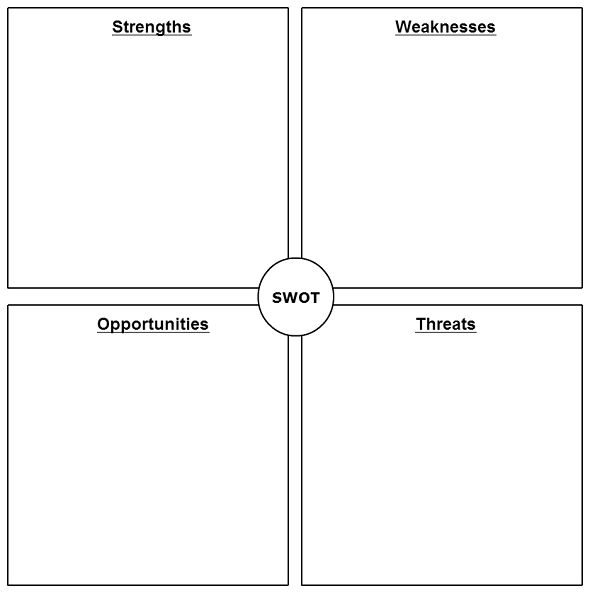
A SWOT analysis chart can be as high-level or granular as you want it to be. I like to use it as a mental warm-up exercise – something to get me thinking and to fire up my inspiration. For that reason, I like to keep it high-level and basic. Here are my rough steps:
- Set up the four quadrants: Strengths, Weaknesses, Threats, Opportunities.
- Start adding bullet points or a list in each quadrant. These can be off the top of your head and/or from existing brand and marketing materials.
- Layer in research. Poke around the interweb to find what customers, competitors, and analysts are saying. You might even look at Glassdoor to find employee insight.
- Step back and analyze what you see. Are there things that jump out? Do you find any patterns or big red flags to address? Make note of those.
- Revisit this exercise periodically.
How to Do a SWOT Analysis for Your Brand
Now that you have the rough framework of a SWOT, let’s go through the exercise. Grab a piece of paper or whiteboard and explore these concepts. (Note: I really do recommend that you get off your digital device and perform this exercise with a pen, pencil, or whiteboard marker.) Aim to write at least five items in each quadrant.
1. Strengths
Think through Your Marketing Strengths. What does your company do really well? What evidence do you have for those proof of concepts you create? What brings in buyers, garners you excellent buyer reviews, or love letters from your customers? Write those things down. As I mentioned earlier, you don’t have to do this all on gut. Pull from your current marketing copy, as well as from industry analysts and customer testimonials.
2. Weaknesses
Next up is Weaknesses. Now, as marketers, I know that we’re wired to constantly find a positive spin. But let’s get real here. I’m sure you have opinions or at least hunches about what doesn’t work so well with your marketing strategy. Write those down. Complete a post-mortem on a deal that your company lost with your sales team. Go back to those customer reviews and feedback – what are some of the common complaints or issues? What does your customer support team receive a lot of calls about? Write those things down, too. You don’t have to engage in endless brand-flagellation but do accurately identify your trouble spots.
3. Opportunities
Opportunities are fun. They can be aspirational – such as places you could expand your marketing reach or new tools your team could employ to add efficiency in your department. Also, brand expansion or messaging possibilities go here. For example, have your customers mentioned something they really want, or have you brainstormed great ideas but not shared them yet? Note those. Reach for the low-hanging fruit, of course – but also include your “stretch” goals ‒ those pie-in-the-sky ideas can’t become reality unless you speak them. This is your space to dream, so do so.
4. Threats
Finally, Threats. What real or potential things could threaten your business? This can be anything from someone stealing your idea to an economic crash, or a potential acquisition. Some of it you may be able to see coming – other things, you can’t even begin to imagine. But try to think through a few disastrous scenarios and jot them down. And, again, be real. There’s no point in hiding the truth from yourself.
SWOT Analysis Example for B2B Marketing Automation Strategy
If you were creating a SWOT for your marketing automation platform (MAP), a strength could be that you have integrated your MAP with your customer relationship management (CRM) tool.
If you were creating a SWOT for your marketing automation for B2B strategy, a weakness is that you’re underutilizing the functions in the platform. This could be not setting up account, demographic, and behavior-based segmentation for your lists. It could be not creating automated B2B nurture programs based on those new segmented lists so that you are nurturing decision-makers, influencers, tire kickers, and folks wanting to buy today all differently.
An opportunity is to expand your MAP’s impact by building more advanced, personalized, and multichannel marketing programs that align with the buyer’s journey. For example, you could implement intent-based automation using behavioral signals, website activity, and firmographic data to trigger highly targeted campaigns. This would allow you to reach accounts earlier in their research process, accelerate deal cycles, and increase conversion rates. You could also integrate additional tools — like ABM platforms, data enrichment providers, or AI content assistants — to create richer segmentation and more adaptive automation paths.
One of the biggest threats to your marketing automation strategy is not using the product or integrating it with your CRM so that you fail to connect your marketing efforts with sales and see the return on that investment. Another threat could be locking yourself into an all-in-one vendor technology stack that isn’t motivated to innovate or address your specific needs.
Know What to Do with Your SWOT Marketing Analysis
Great work on completing your SWOT. Now go stretch your legs for a moment, grab a coffee, and return with your analyst hat on. Look at your list and see what stands out. Circle the big-ticket items. Draw lines and correlations between the quadrants. Jot notes in the margins. Brainstorm – ideas big and small.
The Opportunity in your SWOT for your marketing automation strategy is using your platform across the customer’s journey and across marketing. Are you using it for your branding efforts by nurturing industry and media influencers? Are you creating automated programs for your customers, making sure you help them successfully onboard with your product or service? As they engage more and more, whether attending a customer webinar or Tweeting your praise, you can assign them a lead score for becoming brand advocates and future referrals, as well as priming them for renewals and upsells.
It’s totally OK if you are creating a SWOT analysis just for yourself. It can be a great tool to help you understand more about your brand or simply generate new ideas. But those SWOT results can also be invaluable to your colleagues and boss. I encourage you to share your results – to polish up your lists, remove those potentially thorny items (such as the mention of the CEO’s temper) – and turn your activity into action.
Also, as you drew up your list and made your analysis, I have no doubt your mind started wheeling with ideas. Don’t lose those – whether they be for new products or services, customer opportunities, marketing ploys, campaign slogans, or staff shufflings. The point of the SWOT is to take stock and get ideas going, so harness this energy and good work.
Add a SWOT Analysis to Your Regular Exercises
I am an avid fitness fan, and as such I’m accustomed to working through many of the same exercises – pushups, sit-ups, and squats – over and over again. It’s not because I always enjoy them; but rather, because they work. Think of a SWOT analysis in this same way. No, I’m not suggesting that you need to perform SWOTs as often as squats, but I do encourage you to try a SWOT at least once a year. You may be surprised at how each iteration garners new insights and helps you nimbly adjust your marketing strategy accordingly.
Bonus Exercise: SWOT Yourself
At one of my former jobs, part of the new-hire process included a self-SWOT. We had to assess our strengths, weaknesses, opportunities, and threats when we were hired, and then again at our 90-day review. It was a little strange at first, but the exercise proved to be a great mechanism to help me honestly assess my skills – and also to see what changed over the course of a few short months.
I encourage you to try this. You never know when you may be able to use these findings, too. You can keep them in your back pocket when you’re preparing for your annual review, asking your boss to include you on a big-ticket project, or pitching for a promotion.
Summary
A SWOT analysis is a simple yet powerful framework for examining your brand or strategy from every angle—what’s working, what isn’t, where you can grow, and what risks to anticipate. By organizing your thinking into strengths, weaknesses, opportunities, and threats, you gain a structured view of your B2B marketing automation strategy and uncover insights that can guide segmentation improvements, campaign innovation, and cross-team alignment. Once completed, a SWOT serves as both a strategic snapshot and a springboard for new ideas, helping you continuously refine your marketing approach and stay ahead of evolving customer needs.