


TL;DR: Manufacturing marketers can more easily defend their impact in 2026 by tracking more metrics that tie marketing activity to pipeline and revenue. These manufacturing marketing metrics include pipeline contribution by source, lead-to-opportunity conversion, buying group engagement, long-cycle revenue attribution, and marketing-sourced revenue. Together, these metrics help your team prove more value and replicate your highest-performing activities.
Introduction
If you’ve ever sat in a leadership meeting fielding questions that basically translate to “how much revenue did marketing help create?” you know the importance of metrics. The challenge is that there are dozens of metrics you could track, but many of them still don’t tell the full story about the impact your team is making. And with the marketing trends for manufacturers showing budgets heading downward, you need every defensible point you can make.
The reality is that prospects can spend months researching, learning, and comparing options before building internal consensus and closing a deal. Research shows the average sales cycle in the manufacturing industry is roughly 130 days.
During that period, marketing is working hard, often creating nurture sequences, website content, webinars, and more to keep prospects engaged throughout their entire journey. That’s why it’s worth revisiting the manufacturing marketing metrics you’re tracking and the story they tell, so in the months ahead you can paint a clearer picture of marketing’s impact to leadership and focus on doing more of what’s working.
Five Manufacturing Marketing Metrics That Matter Most in 2026
Even if you’re diligently tracking metrics, it’s easy to get stuck when there’s a disconnect between those metrics and pipeline contribution. And while you’ll likely want to keep some of your favorites, we’d also recommend considering these five marketing metrics for manufacturers in 2026.
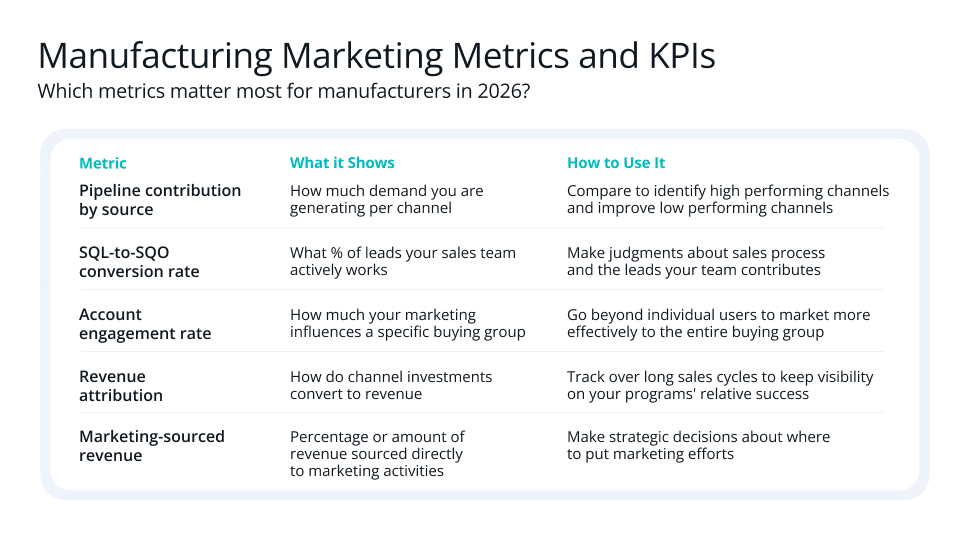
1. Pipeline Contribution by Marketing Source
It’s rare for a large amount of revenue to come from a single campaign, channel, or event. More often, revenue results from a combination of channels that build over time, leading up to the final interaction: the sale. In other words, prospects typically come to you through a mix of activities, such as webinars, email campaigns, and trade shows. And that’s what makes tracking tricky.
Capturing all this activity requires visibility into a very long, multi-touch buying journey. Tracking pipeline contributions by marketing source by using Act-On’s marketing automation platform helps you use first-party engagement data and tie it back to known contacts and accounts. This gives your team a much clearer understanding of how different marketing sources contribute to revenue, from early awareness through opportunity creation.
2. Lead-to-Opportunity Conversion Rate
Successful lead generation strategies for manufacturers focus on quality. Lead quality is essential because you’re working with technical buyers, large buying committees, and long sales cycles.
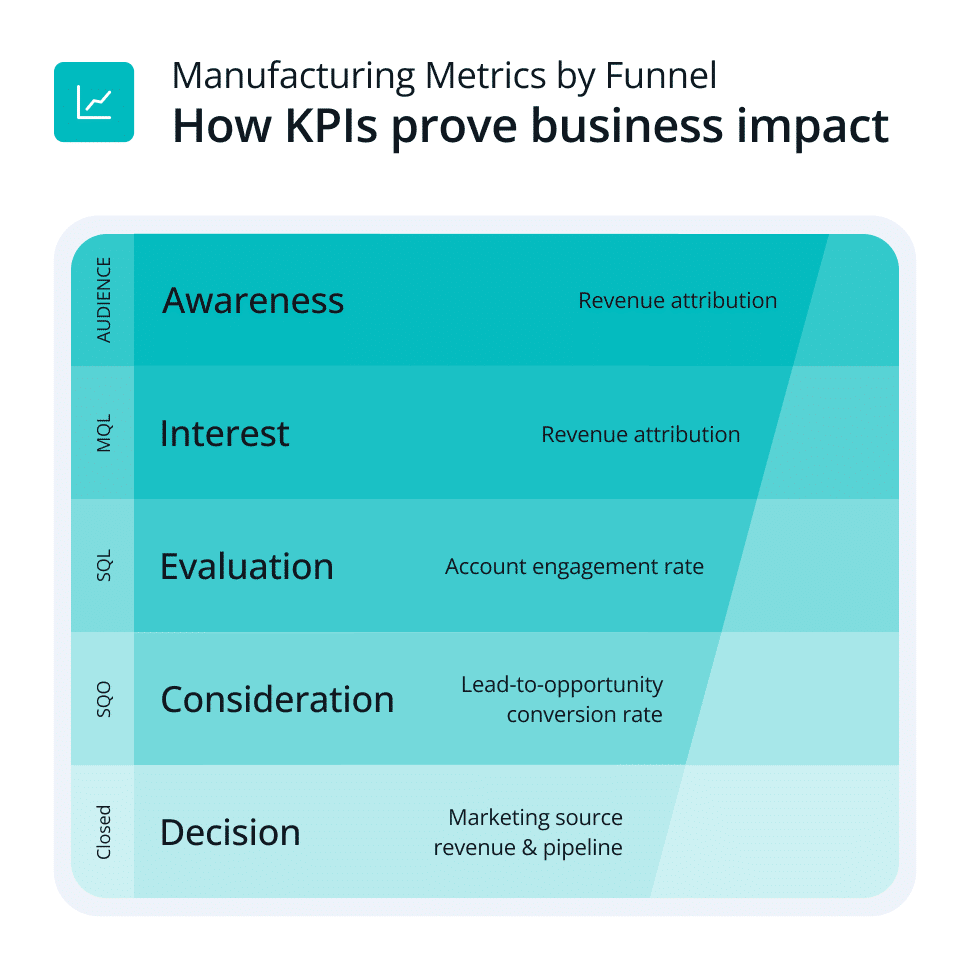
When you’re considering manufacturing marketing metrics, focusing on lead-to-opportunity conversion rates helps prioritize quality and understand exactly how buying decisions progress. For example, an engineer might download a spec sheet, while someone in procurement reviews a pricing guide or reads a white paper about ROI. You need to know what information each member of the buying committee needs and when.
Tools like marketing automation help you measure lead-to-opportunity conversion and apply lead scoring based on engagement patterns, content interactions, and behavioral signals over time. This is especially helpful in manufacturing, where intent to spend builds gradually across many touchpoints. It also gives your team a much better understanding of which campaigns and content produce leads that convert, so you can double down on what’s working without increasing your budget.
3. Account Engagement Across the Buying Group
As you track manufacturing marketing KPIs and metrics, you probably know it’s incredibly uncommon for just one person to hold all the decision-making power, which means you need to measure account engagement across the entire buying group and multiple channels.
For example, a deal might include engineers evaluating the technical fit of your solution, people in operations weighing reliability, and finance professionals assessing cost and risk. You may also have someone in procurement managing vendor approval.
So, if you’re looking at engagement activity through a single contact, it limits your view of the full buying group and doesn’t tell the whole story.
Measuring account-level engagement gives you a clearer picture by showing whether multiple roles within an organization are actively researching and interacting with you over time. Some automation tools support this by tying engagement data back to accounts rather than individual contacts. And as different roles in the buying committee interact with your website, emails, and online events, those activities roll up into a shared view, so you can see patterns, track engagement, and act on them throughout long sales cycles and complicated buying decisions.
4. Revenue Attribution Over Long Sales Cycles
Revenue attribution is especially tricky for manufacturers because deals unfold over a long series of interactions. Research shows that over half of industrial buyers make a purchase decision before they ever speak with a manufacturing company. A buyer might engage with your content for months before the opportunity is created, attending a webinar mid-cycle, and perhaps revisiting your resources during the final evaluation. That’s why relying on first-touch or last-touch attribution oversimplifies how buying actually works, and undervalues marketing’s role.
As a result, attribution needs to acknowledge that revenue is won over a long period, across channels and stakeholders. A tool like marketing automation can help you measure manufacturing marketing metrics, such as revenue attribution across a long sales cycle, by analyzing interactions throughout the entire buying journey.
Instead of piecing together disconnected data from different systems, automation gives you a complete view of the marketing opportunities as they progress. As manufacturing trends continue to push teams toward greater accountability and revenue alignment, this visibility makes it much easier to evaluate influence across multiple touchpoints, understand which efforts tend to appear in successful deals, and do more of what works in the future.
5. Marketing-Sourced Revenue
Marketing-sourced revenue is one of the clearest ways to show your impact to leadership, especially when leadership is focused on tight alignment between spend and pipeline generation.
Unlike basic B2B manufacturing marketing metrics like activity, marketing-sourced revenue connects your efforts directly to business outcomes. Rather than reporting on email engagement or lead volume, you can point to the dollar value of pipeline and closed revenue that originated from marketing-created opportunities.
Marketing automation supports this by capturing and organizing first-party signals that show when an opportunity originated from marketing activity. This includes tracking engagement across content marketing, email, events, social, and website interactions, then tying those signals to individual contacts and rolling them up to the account level over time. When an opportunity is created and eventually closed, that full view of engagement provides a clear context for why marketing is credited as the source.
How Automation Tools Make Metrics Actionable
Defining the right manufacturing marketing metrics to track is step one. Step two is having the tools that let you track them easily and quickly.
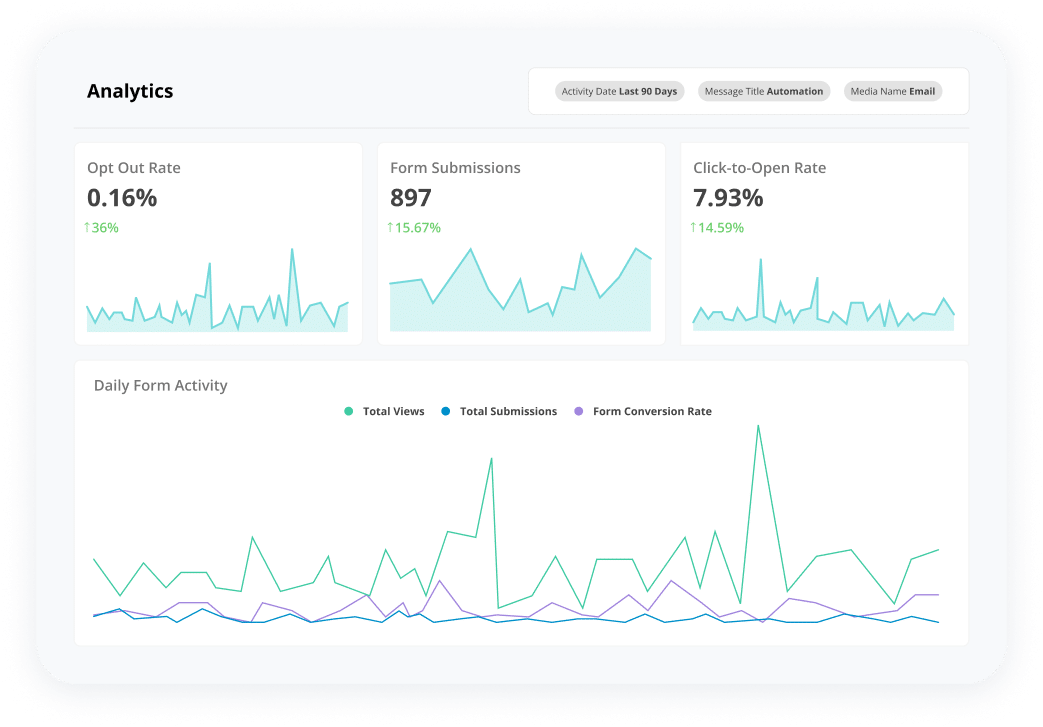
Centralizing data is the starting point, because you can’t track the right information if you don’t have access to it or if it’s fragmented. And that’s also one of the many benefits of marketing automation in manufacturing. It allows you to track data across channels and touchpoints and bring those interactions under a “single roof.”
As a result, you can make better budget decisions and clearly defend them to leadership. And as you move into 2026, you’ll have both the right manufacturing marketing metrics and the right tools to guide smarter decisions and replicate what’s working at scale.
Summary
In 2026, manufacturing marketers need metrics that clearly connect marketing activity to pipeline and revenue — not just engagement. This article breaks down five manufacturing marketing metrics that matter most, including pipeline contribution by source, lead-to-opportunity conversion, buying group engagement, long-cycle revenue attribution, and marketing-sourced revenue. Together, these marketing metrics for manufacturers provide a clearer picture of marketing’s true impact, help teams defend budget decisions to leadership, and identify which activities are worth scaling in long, complex sales cycles.
Ready to improve manufacturing marketing ROI? Check out our The Ultimate Guide to Manufacturing Marketing eBook to start.
Or, if you’re ready to see how marketing automation can support your business right now, getting signed up for an Act-On demo is fast and easy.