


TL;DR: Even with tight budgets and long sales cycles, manufacturing marketers still have plenty of exciting opportunities in 2026 when they focus on the right trends. These include shifting from lead volume to revenue contribution, using marketing automation as an operational backbone, supporting buyer-led journeys, prioritizing first-party data, applying AI for insight, evolving ABM to support buying groups, and investing in credibility-building technical content that builds trust.
Introduction
For 2026, many marketers are keeping a close watch on manufacturing marketing trends while dealing with longer sales cycles, increased leadership demands, and shrinking budgets.
Recent manufacturing marketing statistics show that B2B manufacturing CMOs reported a drop in marketing budgets from 8.5% of total revenue in 2023 to 6.7% in 2024, and more recent research suggests the figure may be closer to 1%–3% of total revenue.
So if you feel squeezed to deliver more trackable results with fewer resources, you’re not alone. Many manufacturing marketers are facing the exact same challenge.
However, that doesn’t mean the year isn’t full of exciting new opportunities, many of which are tied to manufacturing marketing trends. And when you can connect your marketing strategies to these trends, you can capture momentum, and meeting leadership goals becomes much easier.
Seven Manufacturing Marketing Trends for 2026
As you plan your strategies for the months ahead, understanding emerging trends can give you a tailwind that helps push your team closer to success. Here are seven marketing trends for manufacturers to watch, and how to use them to give your team an edge this year.
1. Marketing Strategy Shifts From Lead Volume to Revenue Contribution
As budgets tighten, the microscope is also zooming closer on what you’re spending money on and why. As a result, the focus is shifting away from lead volume and toward revenue contribution.
For example, instead of optimizing for how many forms are completed, more teams are focused on engagement from the right accounts, influencing buying groups over long sales cycles, and showing clear impact on revenue and outcomes.
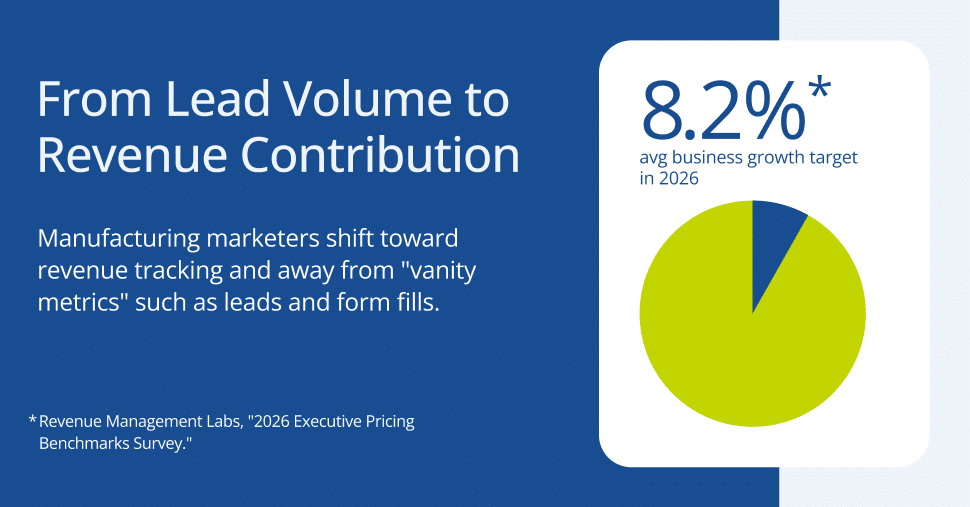
As you consider these marketing trends for manufacturers, tools such as marketing automation are helpful because they connect engagement data across all channels and tie it back to specific accounts, roles, and opportunities. So instead of treating every completed form the same way, teams can understand exactly which signals indicate buying intent and where multiple stakeholders are engaging. These insights along with a slew of manufacturing marketing metrics help marketers focus spending on programs that influence active deals and show their contribution to pipeline and revenue.
2. Marketing Automation Becomes a Core Operational Layer
Research shows that manufacturing CMOs are “optimizing the resources already at their disposal.” And while a resource like marketing automation for manufacturing can support single campaigns, teams focused on optimization are also shifting away from using it only for one-off efforts and toward using it as a core operational layer. But what does that actually look like?
It basically means connecting the data, engagement, and measurement across all channels so that each new interaction builds on the last.
For example, instead of launching a one-off email or gated asset and measuring it in isolation, teams can track how engineers, procurement stakeholders, and executives from the same account engage across emails, web pages, and webinars, and then allow sales to follow up accordingly. These signals roll up at the account level to trigger more relevant messaging and nurture paths, while giving marketing and sales a shared view of exactly what’s happening. All this happens through the core operational layer, which connects all of the different ways prospects interact across channels.
3. Buyer-Led Journeys Replace Linear Funnels
Wouldn’t it be nice if manufacturing buyers moved neatly from becoming “problem aware” to making a decision? However, the reality is that prospects now interact very differently, shifting toward more buyer-led journeys.
What’s more, manufacturing marketing statistics show that 57% of industrial buyers make a purchase decision before ever speaking directly with a manufacturing company. And if buyers aren’t moving along a straightforward path, we need to meet them exactly where they are, with what they need.
This is likely why more manufacturing marketers say they’re prioritizing customer journey experience optimization over channel-specific optimizations. Further research shows that those who maintain a “holistic channel strategy” are 43% more likely to exceed revenue goals than those with a siloed approach.

For example, an engineer may first engage with a technical white paper, while a procurement stakeholder may initially engage through pricing or compliance content on your website. A buyer-led approach uses engagement signals across channels and audiences to adapt messaging, surface relevant follow-up content, and nurture the right buyers with the right interactions over time. They also use digital marketing strategies for manufacturers to strengthen content and interactions.
4. First-Party Data Strategy Separates Leaders From Laggards
Third-party data is useful, but we’re seeing a manufacturing marketing trend toward using first-party data more strategically to lock in the results your leadership team is pushing you to achieve.
And the good news is that marketers already have access to a decent amount of first-party data. This includes your website data, content interactions, event data, and CRM systems. You can tap into this data to better understand prospects, segment audiences, and create more relevant messaging and interactions.
For example, you can use first-party engagement data to identify accounts that repeatedly consume content, attend webinars, and visit pricing pages, then follow up with personalized nurture sequences or direct sales connections at the right moment. These consistent, well-timed interactions create more opportunities and drive pipeline movement over time.
5. AI Shapes Marketing Direction — Not Just Execution
AI continues to be important for manufacturing marketers, but for far more than just generative AI use cases. We’re seeing a manufacturing marketing trend among marketers using AI to identify patterns, which helps them better understand how to use resources and shape strategy.
For example, teams might use AI-driven insights in marketing automation tools to surface early buying signals across multiple channels or identify exactly where engagement typically drops off in long sales cycles. With this data, teams can then adjust the content, timing, or channel mix to refocus resources on the programs most likely to impact pipeline and revenue.
6. ABM Evolves to Support Multi-Stakeholder Manufacturing Deals
Account-based marketing (ABM) is on the rise, and for good reason. Research shows that 76% of marketers report higher ROI with ABM than with any other marketing channel. This is especially important for manufacturing marketers working through long sales cycles, as it helps teams focus on high-value accounts and personalize messaging across many stakeholders.
For example, teams can group engagement by role, such as engineers, procurement stakeholders, and executives, and then personalize content and outreach based on each role’s challenges and priorities. Then, as different stakeholders engage with content, whether through email, web pages, or social, those signals help determine what to deliver next for more targeted follow-up.
7. Technical Content and Credibility Outperform Volume Publishing
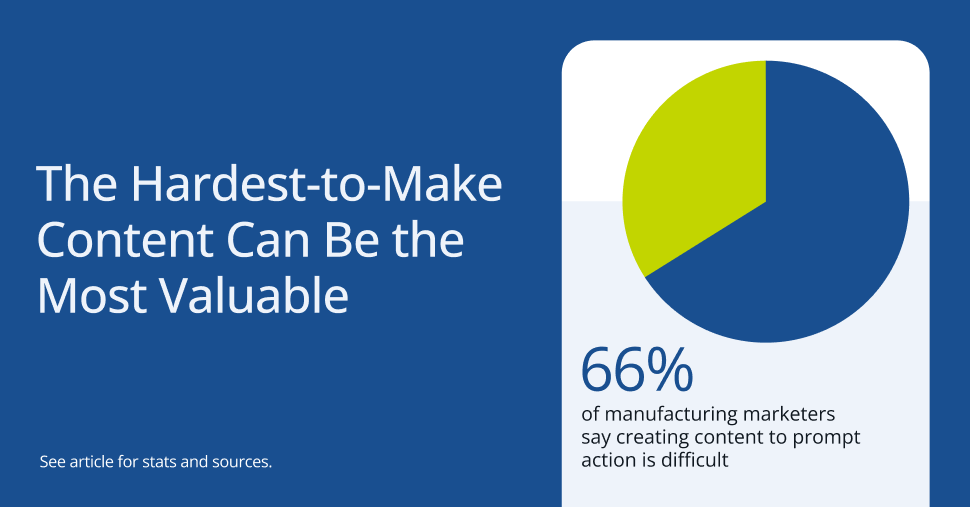
Research shows that marketers are struggling to create content that converts. One survey revealed that 66% of manufacturing marketers report that creating content that prompts a desired action is hard. What’s more, even though teams are creating a wide range of content, from data sheets to interactive content and e-books, only a few key categories are producing the strongest results.
That same research found that when asked which types of content perform best, manufacturing marketers pointed to videos, case studies, customer stories, and white papers. As a result, it will be even more important to focus on high-quality technical content rather than sheer volume moving forward.
What These Trends Mean for Manufacturing Marketing Teams
As your team moves into 2026 and faces tighter budgets and sales cycles that continue to stretch out, success will depend less on activity and more on tying your efforts to revenue. And when you use a marketing automation platform to connect the results to what you’re doing, you can replicate what’s working, stay ahead of long sales cycles, and create the momentum you need to drive success in the new year.
Do you want to take advantage of this year’s manufacturing marketing trends and generate higher-quality leads? Check out our e-book, The Ultimate Guide to Manufacturing Marketing, which lays out a clear road map for using automation to connect with buyers throughout long sales cycles and reach them even during the darker phases of the buying journey.